Wednesday, 16 April 2014

Almost ready

Folder Redirection

EISNet has been improved in all areas as we have mentioned many times. However, one aspect that we have not discussed so far is folder redirection.

A common problem for EISNet users prior to v1.8 is the limitation of remote working and saving files to the desktop. For example, it has not been easy to allow users to work from home using their EISNet laptop. We implemented a homework user to get around the issue, but for v1.8 we have opted to complete re-invent the way users home and desktop folders are managed.

We have implemented folder redirection for many of the common user folders. A notable benefit of this is any user can now save files to the desktop without fear of having the files deleted when they logoff.

The users desktop folder as seen from the server

Previously in v1.7 and below, when a user logs in the Desktop would be created by our LoginScript tool. It looks for allocated software and whether that software is installed on the device. If it is, it creates the shortcut. When the user logs off, the profile, and more importantly, the desktop folder is deleted because it's stored locally on the PC or laptop. This meant, if a user had saved any files to the desktop, they would ultimately be deleted as soon as the user logs off.

In v1.8, the Desktop folder is now redirected to the users personal folder. When LoginScript runs, it now only deletes shortcuts it has previously created and ignores any other files.

In addition, we also redirect their documents, download, favourites, music pictures and videos folders.

Personal folders for a test user

This offers us the ability to allow users to work completely offline, as long as they are assigned a roaming profile. Offline Files are assigned to these folder which means Windows synchronises them at login and logoff.

Now that the desktop folder is held and used centrally it creates a problem where a user logs into two devices at the same time. The desktop folder is shared between the two devices, so if you create a text file on one, it will immediately appear on the other. This may seem a benefit, but actually it creates an issue with software shortcuts. When the 2nd PC logs in, Loginscript will delete any shortcuts it's previously created meaning the 1st devices desktop icons will be removed. Further more, the 2nd device will create shortcuts for software that the 1st does not have, resulting in blank unusable links.

We foresee this as being a significant issue for end users.

Restricting Duplicate Logins

As a result of this problem, EISNet v1.8 now stops users logging in at the same time on two different machines.


If a user attempts to login when are already using another device, a friendly message is shown and will return them to the login screen.

Introducing the Logoff Button

With the introduction of Windows 8.1 support to EISNet, we have evaluated where it will work for children of all ages. One particular issue in relation to Windows 8.1 is the inability to logoff the device easily.

A regular user would need to click on the Start Button, which then presents the All Apps view on EISNet. From there, the user would need to go to Metro, then click their Username, then select Sign Out. It seems simple when written in this blog, but a teacher trying to teach KS1 children how to do this is particularly challenging.

As a result, we have added a friendly Log out button for pupils of all ages.


The Log out button is a site wide option and can be turned off from within EISNet Management Studio.

Wednesday, 9 April 2014

See EISNet v1.8 at our IT14 exhibition

EISNet v1.8 will be officially released at our annual IT conference and exhibition in Ashford on June 12th 2014.

Come and see for yourself all the improvements and how it can improve your curriculum ICT network.

More information

Monday, 10 February 2014

Internet Favourites - Controlled by Staff

EISNet has always supported a form of managed favourites that allow staff to create internet shortcuts that appear for all pupils. However this was not ideal as it meant pupils could view only the favourites created by staff, and not their own. 

EISNet v1.8 includes a much improved internet favourites system for staff and pupils. 

Firstly, all staff and pupils can create their own shortcuts and it remains stored with them regardless of whether they are roaming or mandatory profiles. The important change we have implemented is a folder in everyone's favourites is called 'Shared'. Staff can create internet shortcut's and put them in the Shared folder. This is achieved by creating a favourite in the normal way using Internet Explorer.

Pupils also see this Shared folder, but they cannot edit the contents. 

This is a good method of sharing internet favourites for pupils during lessons.

Enabling packages for all users and the Package Deployment Overview

In previous version of EISNet it was not possible to Enable a package for all users. You could enable packages for Staff, Pupils and Managers (and any level below) but a generic, all levels approach was not possible.

Today we have added this as an option. Simply right clicking the Users node in the main EISNet structure now gives you the option to assign login messages and enable software for everyone.


Finally for today - quite possibly the most useful addition to package deployment we have added since EISNet v1.7 was released - the Package Deployment Overview. This tool, written by our colleague John Fermor, allows you to see which packages are deployed (or deploying) and their current state. It updates live, so there is no need to refresh the page.


Friday, 7 February 2014

The return of the login message

When coding on something complex, it is sometimes good to take a break and work on something else for a while. This helps avoid becoming stuck on a particular problem. This week I found myself in this exact position whilst working on EISNet profiles so I chose to work on something else.

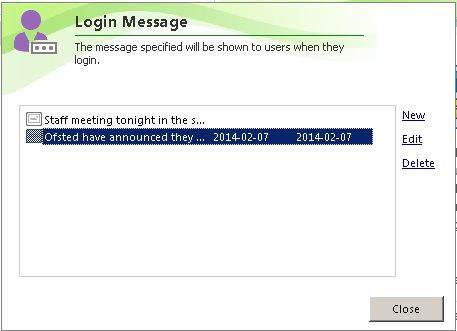
A number of customers have requested a feature that did exist in EISNet before v1.7 which was the ability to do a login message, or a 'Message of the Day'. This is fairly simple to add in, but we don't like doing things by half. If we are going to put a feature in, it's got to be solid and dynamic that could work to as many requirements as possible.

Introducing Login Messages

In EISNet Management Studio, we have added a option to show a login message for Pupils, Staff or computers, and at any possible level beneath. For example, you can set a login message to appear for a particular user, intake/class, key stage area or all Pupils (or staff) . Like wise, you can also set a login message for a particular computer, room or all devices.


You can set a Valid From date and a Valid To date, so that the messages expire when they are no longer relevant. In addition, you can choose whether to show the message when the user is logging in, or after they have logged in. On the screenshot below, you'll notice 'Show on wallpaper' this may be added at a later date, but probably won't be in the v1.8 initial release.


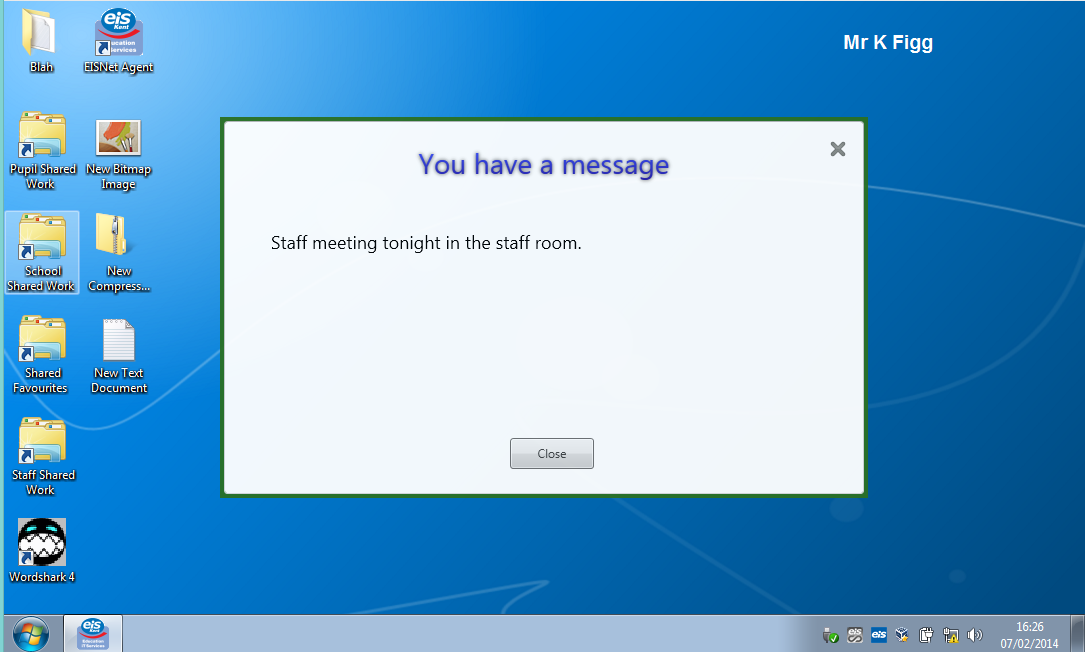
The first thing after logging in is a welcome message to the end user. When a staff member logs in, it shows their title (Mr/Mrs/Miss) and surname (for the techies reading this, this is actually the 'displayname' field in Active Directory). For pupils however, it simply shows their first name.


When a message is shown during login, it will show for four seconds before moving onto the next message (assuming there are more than one message to display). In this instance the login is halted whilst the message is displayed, but it will automatically continue once all the messages are read. In a later release, you will be able to customise the amount of time it waits, on a per message basis.


Finally, if a message is set to show after login, they will be shown the message in a familiar prompt style. The user can still use the device and work as normal whilst the message is displayed.


If there are more than one message to display, the window will show 'You have new messages' and also show a 'Previous' and 'Next' button to navigate.

Now that's done - back to Profiles.


Sunday, 26 January 2014

New year update

Profiles

Our focus is now moving to the support for Windows 8.1. One major complication we had when testing with Windows 8.0 was in the area of Profiles.

We have had to adapt EISNet to support the new versions of Windows profiles on Windows 8 and this has meant a re-write to some of the core profile code.

This has also meant we can now work to supporting proper roaming profiles and offline files for a user. This means they will be able to take their laptop home and use it away from their school network without having to log in as 'homework' each time.


Firstly, each user can have a Mandatory or Roaming profile. The current mandatory profile is shown and you can change the profile to another mandatory at any time.


If you select 'Roaming' you will immediately be asked for a template profile to base the new profile on. Once you click OK, the profile will be created and the user can roam on and off the network.


Revisiting the user properties shows you the location of the profile and gives you the ability to view the folder in explorer. In addition, should you want to reset the profile, you can now do this from within EISNet Management Studio.


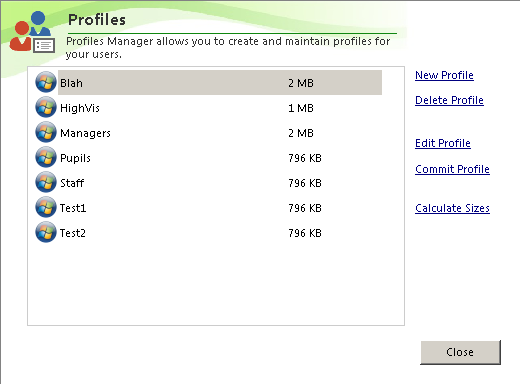
Profile Manager has been practically rewritten to support multiple Profile versions.In addition, it's been rewritten to deal with future profile versions that may come with Windows 9. We have added back the ability to view the profile sizes that existed in EISNet v1.6, but rather than load the sizes immediately, we allow the end user to choose. This prevents locking up Manager whilst it gets the sizes for each profile.


When you Edit a profile, you can now see which profile has been copied to the ProfileSetup user.


When you commit a profile, you can now multi select the destination.


Finally for profiles, the context menu now allows you to duplicate and reset a profile.


Enabling Software for users

A particular bugbear for users was in the area of enabling and disabling of software for users. In EISNet, there are two steps to allowing software to be used. Firstly the software needs to be installed on the Computer. This is managed within Management Studio by installing the package to a room or computer. You would then reboot the device, or let Manager initiate package changes immediately.

Secondly, whilst the software may be installed on a computer, the users will not be able to see the package until you tell EISNet if they are allowed to use it. This process is known as enabling and disabling a package.


When you enable a package for an end user, you will notice, rather than using a drop down list to show the shortcut on the desktop, it is now a simple tick box.


When assigning a start menu folder for a package, again, rather than use a flat dropbox box which does not show the structure, you are now presented with a treeview of the start menu for you to select it's destination. You also have the facility to create, edit  and delete folders as needed.

Finally for packages, you can now multi select shortcuts to show them on the desktop or start menu folder. For example, when enabling Microsoft Office, you can now select all of the shortcuts, and select the required folder once, rather than for each shortcut as was previously required.

Activation Status

One area we know is becoming an issue is the activation of Microsoft products. Specifically Windows and Office. You wouldn't know if the product key hadn't been entered, or an error stopped it from activating until the end user reported the problem.

So we have started to try and make this a bit easier for the network manager.


The first step is to see the activation status from within the Computer Properties window. This feature requires the device to be on at the time, as we get the information in real-time to ensure the the accuracy. 
We will also be adding at a later date a tool for collating this information and showing it in a grid for an overview of the activation status.

Editing the Keystage Structure

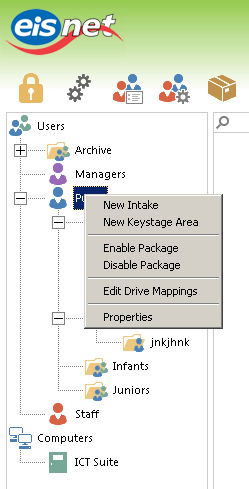
We have added the facility to edit the keystage structure. Some schools prefer not to have Foundation, Infants and Juniors, so we have allowed this to be editable. 


By right clicking the Pupils folder, you now have the facility to Edit the Keystage area.

New Icons

EIS have invested in a new Icon set for our products and EISNet v1.8 will be the first to incorporate them. They give a much more consistent look and feel to the product whilst maintaining the flatness of Windows 8.


Release Date

We aim to release EISNet v1.8 in April 2014. This will enable support for roaming/offline users and Windows 8.1.

Please be aware, EISNet will not support Windows XP or Windows 8.0 (ie, the first release of Windows 8). It only supports Windows 7 and Windows 8.1.

Saturday, 21 September 2013

End of the road for Windows XP

Due to the new components such as Client and Agent being written in Microsoft .Net framework and targeted for v4.5, EISNet v1.8 will not support Windows XP.

EISNet v1.7 is the last version to support the ageing operating system.

So what does this mean for sites that still have XP? EISNet v1.7 will continue to work for the foreseeable future however updates will be limited to major bug fixes only. Currently, v1.7.6 is the last planned version of the v1.7 range but should a major issue be found, it will be fixed and v1.7.7 will be developed.

However, Windows XP will no longer be supported by Microsoft in April 2014. We urge all schools to put into place an upgrade plan to either replace XP devices or upgrade the existing hardware to support Windows 7. EIS are always happy to offer free consultancies to look at your hardware. You might be surprised to learn how much of your devices will work with Windows 7 with just a memory upgrade and Microsoft Windows 7 licence.

In summary, EISNet v1.8 will support Microsoft Windows 7 and Windows 8.1 and is currently planned for release at the end of 2013.